Contents
To help you avoid that stress, we’ll guide you through the process of starting a massage business. In this article, we’ll cover:
- The steps to starting your massage business
- Massage business industry trends
- Starting a massage business: FAQs
Although you may feel intimidated by everything needed to start a massage business, remember that being a massage therapist is extremely rewarding. You’ll see the tangible impact of your care on your clients’ well-being and continuously grow by learning a variety of massage techniques. If that appeals to you, then read on!
 The steps to starting your massage business
- Obtain massage certifications.
- Establish your business plan.
- Acquire business licenses and insurance.
- Set up your finances.
- Choose your name and branding.
- Decide on your practice’s location(s).
- Purchase massage equipment.
- Invest in massage software.
- Determine your marketing strategy.
- Build your customer base.
1. Obtain massage certifications.
Massage therapy is regulated in most states, so you must obtain licensing and certification. Each state has its own regulations and requirements. For example:
- Alabama requires 650 hours of board-approved massage therapy schooling and the completion of 16 hours of continuing education units (CEU) every two years.
- Colorado requires 650 hours of massage therapy schooling.
- Connecticut requires 810 hours of schooling, 750 in a classroom and 60 in a supervised clinic. They also require the completion of 24 CEU hours every four years.
Usually, you’ll need to:
- Attend an accredited school and enroll in a massage therapy program that meets your state’s requirements for the number of hours and specific courses.
- Pass the required exam, such as the National Certification Board of Therapeutic Massage and Bodywork exam (NCBTMB) or the Massage and Bodywork Licensing Examination (MBLEx).
- Register with your state’s massage board and receive your massage therapy license.
- Maintain and renew your license as required by your state.
Note that the massage therapy license is different from the massage business license. The former is a professional certification, whereas the latter is a permit to run a business. You’ll need both to start your own massage practice, but more on that later.
On top of obtaining massage certification, you may also wish to join a massage therapy association. Expert advice is very helpful for massage therapists just starting their businesses, as they won’t have years of experience backing their decisions. By joining an association like the Associated Bodywork Massage Professionals (ABMP) or the American Massage Therapy Association (AMTA), you can network with other therapists, obtain business advice, hear about new opportunities and trends, and even learn industry secrets—all of which will help you further develop and improve your business.
2. Establish your business plan.
The next step you need to take to start a massage business is to lay out your business plan. This will give you a concrete idea of what you want your business to look like and what you want to accomplish.
In your business plan, you should:

- Establish goals and objectives. Define success using several different metrics, such as revenue after a year, number of clients per week, number of repeat clients, and positive customer feedback. You may even set a goal for a certain level of professional development as a massage business owner by learning more about the industry and developing your skills.
- Define your niche. Although it’s tempting to include all massage clients in your target audience, it’s a good idea to appeal to a more specific audience. When deciding on your niche, consider your skillset and the type of people most likely to benefit from it. For example, if you enjoy giving deep tissue and sports massages, you may consider a niche of clients experiencing muscle pain due to stress or injury. If you want to learn more about identifying your business's niche and positioning, listen to the following podcast:
- Analyze competitors. Research other massage businesses in your area, regardless of whether they are targeting your niche or not. Evaluate what they offer, the cost of their services, and the number of clients they serve per week. Locate the gaps in their strategy and consider how you can leverage those gaps to your business’s advantage. You can also determine what your competitors are doing well and apply that to your business.
- Outline your business’s proposed core values. These are a set of fundamental beliefs or actions that your practice will use to conduct day-to-day operations, make important decisions, build relationships, and implement practices that will help you succeed in the long term.
With this plan in hand, you can concretely lay out your vision for the business and determine its feasibility. This document will be the foundation of your massage practice, guiding you to success and profitability.
3. Acquire business licenses and insurance.
After you’ve nailed down the details of your business plan and confirmed that this is what you’d like to pursue, it’s time to start bringing your massage practice to life. To start any business, you must fulfill the legal requirements of your state.
Some of the tasks you can expect to complete include:
- Applying for an Employer ID Number (EIN) with the IRS
- Registering your business
- Acquiring permits and other documents to ensure you can legally run your practice
- Complying with other laws and regulations
As a massage business owner, it’s also a good idea to purchase liability insurance. Since you’ll be touching your clients and manipulating their muscles, you’ll want to protect yourself if a client tries to sue you. In some states, this insurance is required for all massage businesses.
4. Set up your finances.
Before you move any further, you’ll need to set up your finances. Although this may feel intimidating, keep in mind that your finances aren’t set in stone and you can make adjustments to ensure that your business is a success.
To set up your finances, you should:
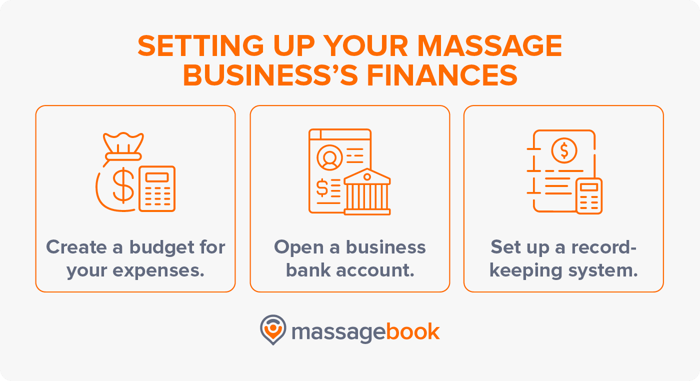
- Create a budget for your expenses. This will help you get a good idea of how much money you need to invest in your business.
- Open a business bank account. It’s essential to keep business and personal expenditures separate, so open a bank account specifically for your practice.
- Set up a record-keeping system. Not only will this help keep your financials on track as you begin accepting clients, but it will also streamline your future tax filings.
You’ll also need to think about how you’ll acquire the funding to start up your business. There are many paths you could take with this, including:
- Using personal funds
- Getting venture capital from investors
- Crowdfunding
- Applying for small business loans
Additionally, it’s helpful to come up with the pricing for your massages at this stage. Based on the budget you’ve created for your expenses and the recurring costs you’ll incur, you can determine prices that are realistic and affordable for clients but also help you reach a certain level of profitability.
5. Choose your name and branding.
This step is a bit more fun than the last few, yet no less important. Your massage business’s name and branding are two main ways that your community and clients will distinguish your practice from all others. That’s why it’s crucial to be thoughtful while you’re making your choice.
Here are some tips:
- Name: Choose a simple yet catchy name for your business to help clients remember it. Keep in mind your niche and try to tailor your name to fit that niche. For example, if your specialty is aromatherapy, you could consider names such as “Garden Massage” or “Aroma Wellness Massage.” Make sure to trademark the name to help you solidify your business.
- Branding: When choosing your branding and aesthetic, you’ll want to make sure it’s clean, professional, and appeals to your target audience. For example, a practice focused on medical massages might choose minimalistic branding with red as a brand color, as it has an association with the medical industry.
Although capturing the essence of your business within a single name and color palette may be intimidating, remember that you can always adjust and change both. Businesses undergo name and branding changes all the time—for example, Nike used to be called Blue Ribbon Sports.
6. Decide on your practice’s location(s).
You can operate your massage business out of several different types of locations, such as your home, a business facility, or your clients’ homes. Here are the pros and cons of each:
| Location | Description | Pros | Cons |
| Your Home | Clients travel to your home to receive massages. |
|
|
| Business Facility | You rent or lease an external space for your massage practice. |
|
|
| Clients’ Homes | You travel to clients’ homes to provide massages, also known as outcall massages or mobile massages. |
|
|
Consider the benefits and drawbacks of each option before making your decision. You can also be flexible with your massage business operations by offering outcall bookings as an add-on. For example, you might run your practice from your home but also offer outcall bookings to capture clients who prefer to receive massages at their homes.
7. Purchase massage equipment.
Common items that massage therapists purchase for their practices include:
- Massage table
- Massage chair
- Pillows
- Linens and towels
- Massage oils, lotions, and cream
- Decorations
- Candles
- Music equipment
Ensure that the items you purchase align with the aesthetics and branding that you decided on. If your brand has a focus on being natural, for instance, then you’ll want to purchase wood or bamboo furniture. You can even take it further by purchasing plant-based linens and oils and cruelty-free lotions and creams. Plus, you can purchase potted plants for an extra touch of green.
8. Invest in massage software.
Although massage software is not technically necessary for running a massage business, the right solution will greatly elevate your business’s operations. These tools can help your practice in a variety of ways, empowering you to:
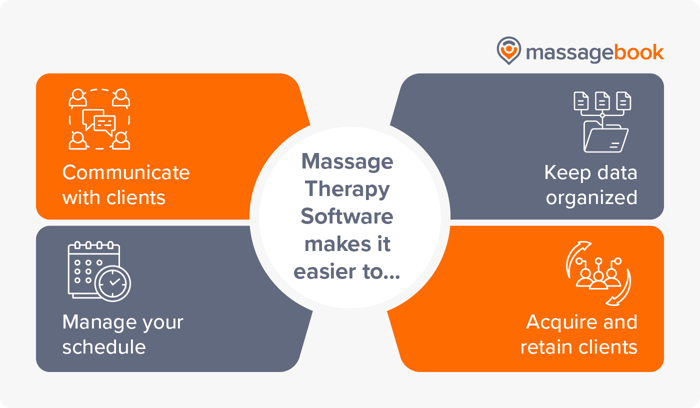
- Communicate with clients. Automate appointment confirmations, digital payment receipts, and reminder emails to keep your clients in the loop.
- Manage your schedule. Prevent double-booking by investing in a solution that keeps track of your schedule and only allows clients to make appointments when you’re available.
- Keep data organized. Maintain secure records on clients that include their visit history, preferences, and any other notes you might make.
- Acquire and retain clients. Massage therapy software often offers marketing capabilities to help your business reach out to new clients. Plus, it provides you with data and analytics that you can assess to help you create a better experience for clients.
Although massage therapy software can be a significant investment for a business that is just starting, it’s essential for therapists who are serious about developing their business. The right solution will streamline your business’s operations, freeing up time in your day and making it easier for you to handle any obstacles that arise.
9. Determine your marketing strategy.
One of the most essential parts of running a business is marketing your products and services effectively. After all, it’s no use if you offer great massages but can’t get anyone in the door. To ensure success with your massage business, you’ll need to establish a marketing strategy.
Common channels that businesses use to market their products and services include:
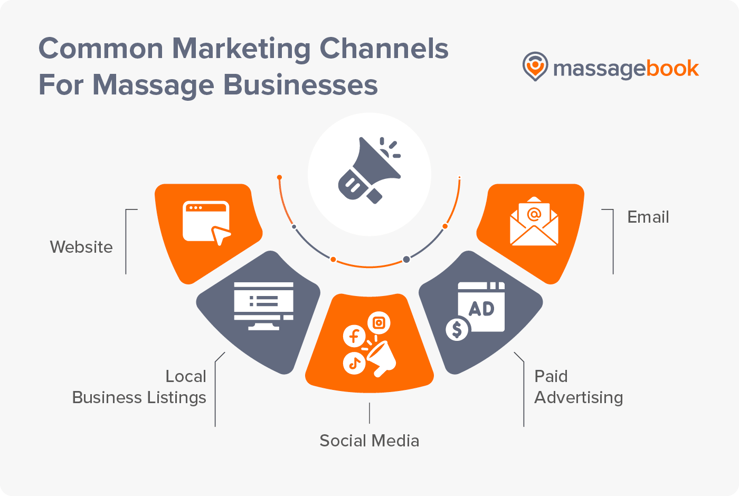
- Their website. When potential clients are interested in a product or service, one of the first places they research is the business’s website. Ensure your website is professional, well-designed, and contains all the information your clients want.
- Local business listings. The most visible business listings are on sites such as Yelp and search engines such as Google. Be sure to list your business on these sites for maximum visibility.
- Social media. Social media platforms are a powerhouse for reaching a wider audience. Popular platforms that businesses advertise on include Facebook, Instagram, and TikTok. Each platform has a different audience, so be sure to advertise on the ones most aligned with your target audience demographics.
- Paid advertising. Businesses with marketing funds to spare often invest in paid online advertising, such as Google Ads or Facebook Ads.
- Email. Email marketing is most effective for individuals who have already contacted your business, most likely because they’ve been clients in the past. Create email campaigns that target these individuals, letting them know about new, exciting changes or offerings at your business.
When you first establish your business, you may not have the bandwidth to manage marketing on multiple different platforms. However, as your business grows, you must diversify your marketing strategy. We recommend focusing on your website and local business listings first and then branching out to social media and email afterward. Once you reach a certain level of profitability, then you can consider paid advertising.
10. Build your customer base.
After you’ve set up your business, it’s time to focus on building a loyal customer base. Provide exceptional massages and customer service so that clients leave with a positive experience, helping to secure their repeat business. Make sure to communicate with them by sending appointment confirmations and reminders. And, clearly outline any steps they must take before their appointment, such as filling out intake forms or providing insurance information for massage billing.
Incentivize client loyalty by implementing a reward and referral program. This type of program has two parts:
- Reward. Show appreciation for your clients’ loyalty and incentivize their repeated patronage by offering them a reward after a certain amount of massages. For example, your reward could be a 15% off coupon after five massage sessions. Or, implement a membership program where a discount is built into the monthly cost of services.
- Referral. To tap into your clients’ networks and promote your business through word of mouth, incorporate a referral program. Existing clients will get rewards for referring new clients to you. For example, you could give existing clients 10% off their next massage if they refer a friend who receives a massage at your business.
While acquiring new clients is important for growing your business, it’s more efficient to retain your existing clients to maintain your practice’s financial stability. Don’t overlook the potential connections you can nurture and create through existing relationships!
Additionally, encourage clients to leave feedback on what they think you could improve. One way to do this is by asking them to fill out a feedback form after their appointment. Earnestly consider the feedback you receive and implement suggestions that would improve your massage business.
Massage business industry trends
Now that you know how to start a massage business, let’s explore trends in the industry that may inform your business planning.
Key takeaways from these trends:
- The massage therapy industry is growing continuously, increasing projected valuation and employment opportunities.
- More and more individuals are booking massages for health and medical reasons, as opposed to relaxation and pampering.
- Women, customers with children, and higher-income individuals are more likely to get a massage.
- Corporations are now offering massage-related wellness benefits to employees.
- Mobile massages and outcall bookings are increasing in popularity.
Industry size and growth
- In 2025, the U.S. massage therapy service market was valued at over $21 billion, and is expected to reach over $35 billion by 2032.
- Employment for massage therapists is projected to grow 15% from 2024 to 2034, much faster than the average for all occupations.
- In 2024, there were over 202,000 massage service businesses in the U.S.
Emerging massage industry trends
According to AMTA’s 2025 Massage Profession Research Report:
- Of the individuals who booked a massage in 2025:
- 62% did so for health and wellness reasons.
- 59% did so for mental health reasons.
- 29% did so for pampering, special occasions, or just to feel good.
- Massage therapy’s growing role in healthcare has led to more referrals, with the majority of massage therapists receiving referrals from:
- Other massage therapists (75%)
- Other healthcare professionals (68%)
- Chiropractic offices (62%)
- Women are more likely than men to receive massages: 1 in 4 women received a massage in the last year, compared with 1 in 5 men.
- Consumers with children under 18 at home are 10% more likely to get a massage than those without children at home.
- The higher the household income, the more likely consumers are to get a massage. In 2025, 33% of those making $100,000 or more got a massage, while only 17% of those making $50,000 or less got a massage.
According to Market Growth Reports:
- 36% of hybrid workplaces now offer some form of wellness benefit, such as massages, indicating that more corporations are using massage to promote employee well-being.
- In-home massage services saw a 21% year-over-year increase in sessions from 2022 to 2023, indicating growing interest in mobile massage and outcall bookings.
Starting a massage business: FAQs
How much does starting a massage business cost?
Massage practice startup costs vary from business to business, with some estimates ranging from $6,000 to $20,000. Generally, you can expect to pay for:
- Massage therapy license (and tuition, if applicable)
- Business license and registration
- Liability insurance
- Rent or lease
- Utilities
- Massage equipment
- Marketing materials
Is starting a massage business profitable?
Starting a massage business can be very profitable, but it depends on how prepared you are going into the process. Establishing your business model, pricing strategy, and client retention tactics early can lay the groundwork for a successful massage practice.
Keep in mind that you get what you invest in your business. If you choose to work part-time as a massage practitioner, you may earn less than if you focused on your massage business full-time.
What massage services should I offer?
We’ve already discussed earlier that you should decide on services to offer based on your business plan, which includes factors like your massage practice’s niche, competitors, and audience preferences.
Here are some common services that massage businesses offer:
- Swedish massage
- Aromatherapy massage
- Hot stone massage
- Deep tissue massage
- Trigger point massage or reflexology
- Foot massage
- Couples massage
What are the common reasons massage businesses fail?
The most common reasons massage businesses fail include:
- Lack of a clear business model
- Not taking the time to identify a niche
- Poor financial management and planning
- Underpricing services
- Not accounting for overhead costs
- Inconsistent marketing
- Poor or no retention strategies
Should I start a massage business?
Ultimately, you are the only person who can make this decision. Running a massage business is an extremely fulfilling line of work for individuals who are passionate about bodywork, service-oriented, and excited to provide care to their clients.
Should you decide to start a massage business, we highly recommend going over the most common reasons massage businesses fail and creating a plan to mitigate those obstacles. This will help you improve your practice’s chances of success.
Additional resources
Starting any type of business is challenging for new entrepreneurs, but it can be very worthwhile. Massage therapy is a rewarding career, and for service-minded individuals, can be extremely fulfilling. With the steps outlined above, you’re well on your way to establishing your own massage business and achieving success.
If you’d like to learn more about running a successful massage business, check out the following resources:
- 13 Best Massage Therapy Software Solutions — Ready to invest in massage therapy software for your business? Discover the top solutions you should consider in this guide.
- Marketing Massage Therapy: Effective Techniques to Explore — Learn how to spread the word about your new massage therapy business with our list of effective techniques.
- Massage Membership Ideas: Creating A Model To Boost Booking — Want to boost repeat customers at your massage practice? Consider launching a membership program!