Contents
In this guide, we’ll cover the following topics to help you learn more about accepting insurance and massage therapy billing codes:
- Massage billing FAQs
- Understanding massage therapy billing codes
- The massage billing process
- How software helps with massage billing
Venturing into the medical world can be overwhelming, as there are many rules and regulations that you need to comply with. Let’s look at the basics of massage billing and medical insurance and help you evaluate whether accepting insurance for massage billing is the right move for your practice.
Massage billing FAQs
Should I accept insurance coverage for massage billing?
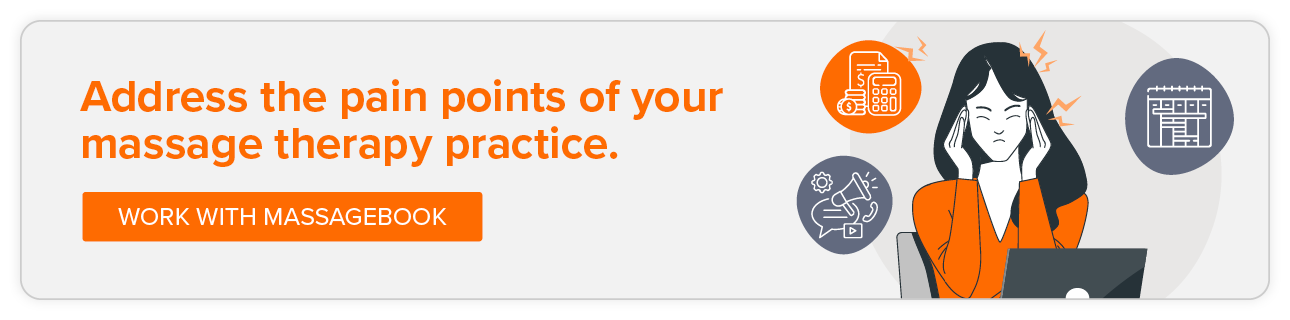
There are many benefits to accepting insurance as a massage therapist, such as:
- Improved massage affordability. Some individuals who need medical massage care may not be able to afford it out of pocket. If your practice accepts their medical insurance, massages will be more accessible to those clients.
- Increased traffic to your massage practice. More affordable massages lead to more bookings. Plus, you’ll be more likely to retain clients, as not every massage provider will accept their insurance.
- Enhanced trust and credibility. By accepting health insurance, your practice will essentially offer healthcare services. This will enhance clients’ trust in your practice to deliver high-quality massage therapy. By highlighting this in your marketing, you’ll also differentiate your business from competitors.
While accepting medical insurance payments offers many advantages, it also has some downsides, such as:
- Navigating insurance coverage. Not all insurance providers cover massage therapy. Research the most common insurance providers in your area. If they don’t cover massages, it may not be worth it for you to accept insurance.
- Increased paperwork. Working with medical insurance requires filling out additional paperwork for insurance companies. You may also need to appeal denied claims, so you must be able to manage extra paperwork on top of existing responsibilities.
- Payment uncertainty. Insurance providers may deny your claims. In that case, you may not receive the entire payment. You’ll need to either bill your patient for the remaining balance or accept the partial payment.
Ultimately, it’s up to you to determine if the benefits outweigh the costs for your practice. Only you know whether you’d be able to successfully accept medical insurance.
How do I calculate “units” for massage billing?
Some massage CPT codes are time-based and billed in 15-minute increments or a “unit.” However, if the treatment duration is not perfectly divisible by 15 minutes, most insurance payers allow you to still bill the unit if it’s over 8 minutes:
- 8–22 minutes = 1 Unit
- 23–37 minutes = 2 Units
- 38–52 minutes = 3 Units
- 53–67 minutes = 4 Units
- And so on
Can I bill insurance for a missed appointment?
No, you cannot bill insurance for a missed appointment or for services not performed. This is considered insurance fraud. If you wish to incentivize clients not to miss their appointments, you can charge a no-show fee and bill it directly to the client.
How long does it take for massage billing to get paid by insurance?
Payment timelines vary from payer to payer, but generally, if you submit your claim electronically, you can expect it to take between 14–30 days. Paper claims take longer, usually around 60–90 days before payment.
If your claim is denied, it will take even longer, as you’ll need to correct and resubmit your claim and await the payer’s final decision.
What is patient reimbursement for massage therapy billing?
While working with insurance has its drawbacks, there’s a way for you to work with clients who need insurance without fronting the risks.
Instead of handling insurance yourself, ask patients to seek reimbursement from their insurance themselves. After you’ve seen a client with a prescription for massage therapy, provide them with a superbill detailing all the treatments they received. The client will pay you for your services and submit that superbill to their insurance provider. The insurance provider will then reimburse the client for the payment they made to you.
Although this strategy still requires additional paperwork, it removes the burden of submitting claims and dealing with insurance providers yourself. It also removes uncertainty around payments, as you’ll get paid either way!
Understanding massage therapy billing codes
What are the most common massage therapy billing codes?
The CPT codes most relevant for massage billing include:
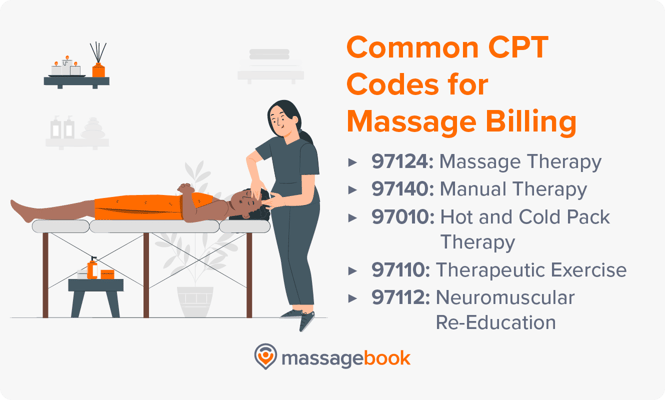
97124: Massage Therapy
This CPT code describes a therapeutic massage procedure in one or more areas. It includes effleurage, petrissage, and tapotement. This code is time-based and billed in 15-minute increments.
Although this massage billing code is similar to 97140: Manual Therapy, it differs in intent. If you’re trying to increase circulation and tissue relaxation, bill 97124: Massage Therapy.
Insurance providers heavily scrutinize the use of this code and will only cover it when medically necessary. This means massage therapists must take robust SOAP notes and provide rigorous documentation if they plan to bill this CPT code.
97140: Manual Therapy
This massage therapy billing code describes manual therapy techniques, including mobilization, manipulation, manual lymphatic drainage, and manual traction, in one or more regions. This code is time-based and billed in 15-minute increments.
97140: Manual Therapy describes therapy that increases active pain-free range of motion, increases the extensibility of myofascial tissue, and facilitates the return to functional activities. You can report codes 97124 and 97140 in the same session only if you apply the unique massage techniques to different areas of the patient’s body.
97010: Hot and Cold Pack Therapy
This massage therapy billing code describes the application of any physical agent to produce therapeutic changes to biological tissue. Most commonly, it describes the application of moist heat, cryotherapy, or hydrotherapy. This billing code is not time-based and may be billed only once daily. If your client has received this type of therapy from another medical practitioner, you will not be able to use this code.
97110: Therapeutic Exercise
This CPT code refers to exercises and activities that are specifically designed to help patients gain better mobility and fitness levels. Normally, these exercises are used on patients with injury-related disabilities, patients who are recovering from surgery, and patients who need relief from pregnancy or osteoporosis. 97110: Therapeutic Exercise is time-based and billed in 15-minute increments.
Although this code is valuable for specific conditions or patients, it was originally designed for use by physical therapists. If you’re not trained or licensed as a physical therapist, your claim will be heavily scrutinized and may be denied.
97112: Neuromuscular Re-Education
This massage billing code is used for therapeutic procedures on one or more areas for neuromuscular re-education of movement, balance coordination, kinesthetic sense, posture, and/or proprioception for sitting and/or standing activities. It is time-based and billed in 15-minute increments.
Like code 97110: Therapeutic Exercise, 97112: Neuromuscular Re-Education was originally designed for use by physical therapists. If your training and licensure don’t reflect experience as a physical therapist, it may not be worthwhile to bill these codes, as your claim will likely be denied.
What are massage therapy billing code modifiers?
In addition to using the correct massage therapy billing codes, you may also need to clarify the intent and activity of your services with a CPT code modifier. Here are two common massage billing modifiers to know:
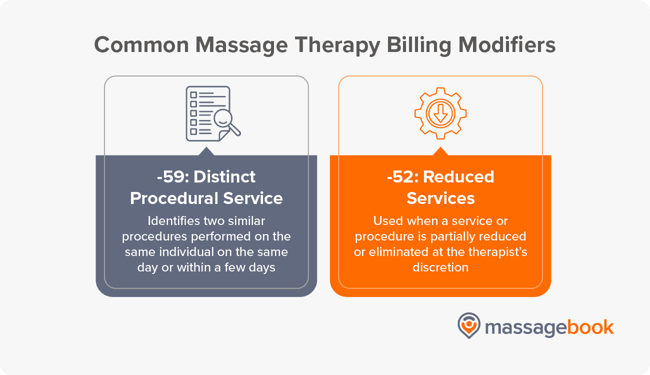
- -59: Distinct Procedural Service. This modifier identifies two similar procedures performed on the same individual on the same day or within a few days. For example, let’s say you’re reporting codes 97124: Massage Therapy or 97140: Manual Therapy alongside evaluation and management codes or chiropractic manipulation treatment codes. Append these codes with -59 to clarify that the massage services you’ve provided are separate from other services performed on the same day. However, using this modifier may raise flags with an insurance company and result in delayed payment.
- -52: Reduced Services. Use this massage therapy billing code modifier when a service or procedure is partially reduced or eliminated at the therapist’s discretion. This modifier may not be used on time-based codes, evaluations, or management services and should not be used to report the termination of a procedure. When using this modifier, explain why the procedure was discontinued and note the percentage of the procedure that was performed.
Double-check that you’re using these massage therapy billing code modifiers in the appropriate situations. Similarly to using incorrect codes, using incorrect modifiers can lead to denied claims.
What are massage therapy timed codes?
Timed versus untimed massage therapy billing codes add another layer of complexity to the billing process. We discussed earlier that certain billing codes are timed, such as 97124: Massage Therapy, which is billed in 15-minute increments. If your massage business accepts Medicare patients, you’ll need to learn the nuances between the two.
Let’s break it down a bit further:
- Untimed codes aren’t billed in specific time increments. This means that you’re reimbursed a predetermined fee, no matter how much time you spend on a treatment. You can only bill these codes once per treatment session.
- Timed codes are billed in 15-minute increments, and you’re reimbursed based on the time spent working with your client one-on-one. You can bill timed codes multiple times per session. If your treatment is not split into perfect 15-minute segments, apply the 8-minute rule—for the amount of time that isn’t divisible by 15, if it is over 8 minutes, then bill an additional unit.
As you fill out insurance forms with massage therapy billing codes, know if the code is timed or untimed to ensure you’re accurately reimbursed.
The massage billing process
Although coding is a crucial part of the massage billing process, it’s not the only thing you have to consider before billing insurance for your services. Let’s take a look at the massage billing process.
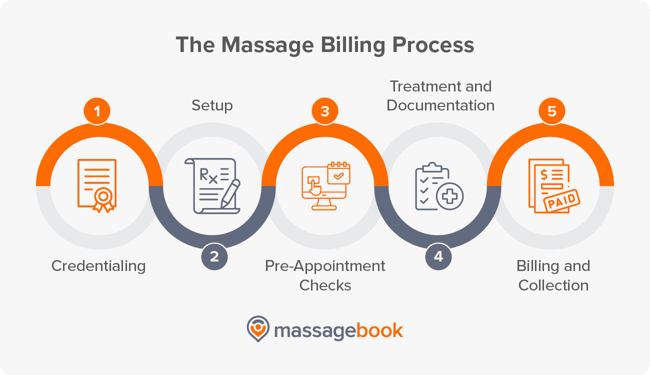
1. Credentialing
To accept insurance as a massage therapist, you’ll need to meet medical credentialing requirements. Double-check how insurance billing works with your state’s massage practice board and ask them any questions you may have.
Generally, insurance billing requires the following credentials:
- Active massage therapy license
- National Provider Identifier (NPI) number
- Educational credentials and continuing education certificates
- Business license
- Employer identification number (EIN)
- Professional liability insurance
After collecting these documents, you’ll begin the credentialing process with various health insurance companies. During this process, you’ll prove that you are a qualified, professional, and trustworthy massage therapist that the insurance company can partner and sign a contract with. This process can take several months, so it’s best to start it as soon as possible.
2. Setup
Review and sign contracts that determine your set reimbursement rates with each insurance payer. These documents tell you the exact amount that you’ll be paid for certain CPT codes, and you cannot start seeing patients until this contract is signed and in effect.
Then, set up everything your massage practice needs to handle massage billing. Typically, this means outlining all your workflows and setting up your billing software or clearinghouse account to submit claims digitally. While you can handle billing manually or by hand, a streamlined tool speeds up the process and makes it easier for everyone involved, including yourself.
3. Pre-appointment checks
At this point, you’re ready to see clients who want to use insurance to pay for their sessions. Before every appointment, check these details to make sure that customers are covered:
- Insurance eligibility: A common issue with massage billing, or any type of billing, is that claims will be delayed or denied due to issues with a patient’s coverage. Confirm your clients’ insurance eligibility and their benefits before appointments to ensure that you will receive payment for your services.
- Prior authorization: Often, payers require patients to obtain approval before they can seek out specific treatments, procedures, or medications. As you verify your client’s insurance eligibility and benefits, also check if the client’s insurance company requires prior authorization before they can seek out massage therapy.
- Massage therapy prescriptions: Since insurance providers usually only cover massage therapy when it’s medically necessary, ensure patients have a medical prescription or referral from a physician. This will include a start date, number of visits, frequency of sessions, and diagnosis codes referencing the patient’s injury or condition. You can also use this information to form a treatment plan for your patient.
If you run into issues verifying any of this information, let your client know before their massage session that you cannot bill their insurance. You can give them the option to either come back once their details are straightened out or pay for the day’s services out of pocket. If they choose the latter option, you can offer them a superbill they can submit to their insurance provider for reimbursement.
Additionally, avoid providing massages on a day when the patient visited another provider. This is because certain massage therapy billing codes have limitations. For example, code 97010: Hot and Cold Pack Therapy can be billed only once per day. That means if your client has received this therapy from another provider on the same day they visit your practice, you may not be able to receive full reimbursement for your massage services.
4. Treatment and documentation
During your massage session, perform prescribed services to the best of your ability. Ensure that the treatment you provide aligns with the prescribed CPT code to mitigate any issues with coding and scrutiny from insurance providers after the fact.
You’ll also need to take detailed SOAP notes that prove the medical necessity of your services. This means you need to show that the patient has a limitation that the massage is fixing or alleviating, whether it’s pain in their shoulders or difficulty with knee mobility. SOAP notes provide a professional framework that helps you do this.
Invest in a system to collect and store information about the sessions you provide, including your SOAP notes. This makes supporting your payment requests easy, as you can send comprehensive records proving that you provided a legitimate service to your clients.
5. Billing and collection
The final part of the massage billing process is the most complicated, but it can be broken down into the following steps:
- Coding: Ensure your claim is coded correctly. Double-check that you’ve used the proper code for the services you provided and added modifiers as necessary.
- Submission: Send your claim form and other documentation to the insurance provider. Typically, this is done electronically through your billing software or a clearinghouse solution.
- Adjudication: The client’s insurance company will process your claim, and you’ll receive an Electronic Remittance Advice document (ERA) explaining payment or denial. If you’ve been denied, you can appeal by submitting a corrected claim and additional paperwork or documentation.
- Client invoicing: Finally, you’ll bill your customer for any remaining balance that insurance did not cover. This may include copays or deductibles that you have not already charged to the client.
Though massage billing is complex, you can facilitate prompt insurance processing by following these steps. Furthermore, robust software can streamline the process.

How software helps with massage billing
Accepting insurance as a massage therapist adds extra work to your plate, and you may feel that this extra effort is not worth the benefits. However, before you completely dismiss the idea, consider that the right massage therapy software solution can substantially improve your massage billing processes.
Some helpful massage therapy software features include:
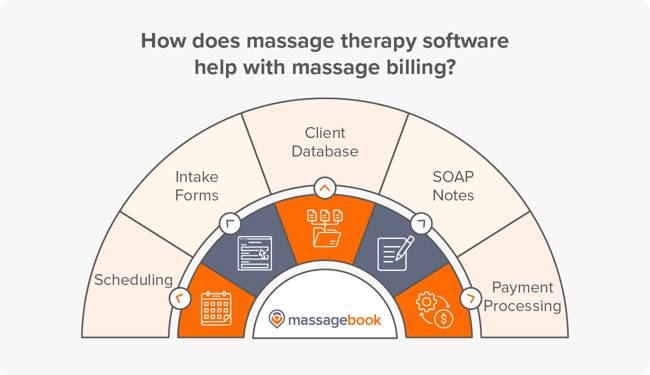
- Scheduling. Since accepting insurance coverage makes massages more accessible and affordable, you may attract more clients. Massage therapy solutions often have online scheduling capabilities to simplify your workflow.
- Intake forms. Ask clients to fill out intake forms online before their appointment with massage therapy software. Use these intake forms to determine if clients are using insurance, verify if they have a prescription or referral, and check if they have another provider visit scheduled on the same day.
- Client database. Track client-specific information in a single, centralized location. This includes appointment history, contact information, and messages. You can also note if your client uses insurance, so you’ll know how to handle massage billing for them.
- SOAP notes. Insurance providers usually require detailed treatment notes for claims. Massage therapy solutions allow you to take secure, in-depth SOAP notes that record massage therapy billing codes. Plus, you’ll be able to create more detailed treatment plans for clients, helping you provide massages that relieve pain and address their medical needs.
- Payment processing. With massage therapy software, you can accept various payment methods, including HSA and FSA, and even split payments between different methods. Some solutions also enable you to offer insurance billing receipts, which list specific info for clients who want to submit receipts to their insurance provider. These receipts include the service date and time and the provider’s name, state license number, and unique NPI number.
Aside from these specific billing-related benefits, massage therapy software is beneficial for your practice in other ways. These solutions can improve client communication, keep your data organized, and even help you acquire and retain clients. Even if you decide not to accept insurance coverage, consider how massage therapy solutions can streamline your practice’s processes and address your pain points.
Additional resources
Although insurance providers have historically overlooked massage therapy, that attitude is changing, and accepting insurance as a massage therapist is becoming more viable. However, many rules and regulations can make it difficult to add insurance to your massage billing processes. Ultimately, it’s up to you to decide whether it’s worth it for your practice to make the change.
To learn more about running a massage therapy business, explore the following resources:
- 10+ Best Massage Therapy Software Solutions — Massage therapy solutions help practices in numerous ways, including making insurance billing more convenient. Read our list of the top massage therapy software solutions.
- SOAP Notes for Massage Therapists: Guide + Free Template — Even if you’re not planning on accepting insurance, having detailed SOAP notes can help you retain clients by providing exceptional massages. Check out our guide and download our free SOAP notes template!
- Massage Therapy Marketing: 15 Effective Ideas to Explore — Promoting your business is just as important as billing and proper service. Explore effective massage marketing techniques here.