Contents
While the wellness industry is booming, nearly half of all new businesses fail within their first five years, often because owners underestimate the administrative weight of their vision. Developing a comprehensive massage therapy business plan is the only way to bridge this gap, transforming your passion into a profitable, sustainable practice.
By the end of this guide, you’ll understand why a plan is instrumental to your success and even get a free template that covers the core components you need to include.

Massage therapy business plan FAQs
What is a massage therapy business plan?
A massage therapy business plan is a comprehensive document that outlines a massage business’s goals and the exact path to achieving them. It integrates competitive market analysis and financial forecasting with industry-specific details like service modalities and therapist capacity. This document serves as a roadmap for launching new practices successfully and as a growth guide for established businesses looking to scale their operations and profitability.
Why do you need a massage therapy business plan?
A massage therapy business plan is essential for turning a clinical skill set into a sustainable company. Specifically, it helps you:
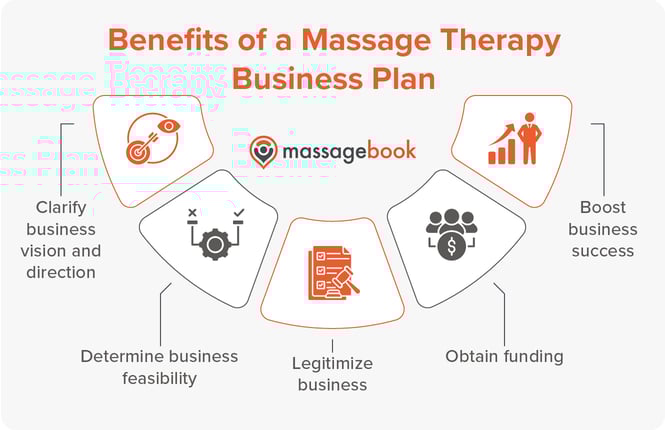
- Clarify business vision and direction: A well-researched plan solidifies your vision, shifting your mindset from solely focusing on massage therapy to that of a business owner with a strategy.
- Determine business feasibility: Before investing capital, your plan proves if your specific business idea, location, and pricing model can actually support a profitable practice.
- Legitimize their business: Whether you’re applying for a business license or negotiating a lease, a formal massage therapy business plan shows landlords and partners that your venture is professional and serious.
- Obtain funding: Funders want to back feasible and profitable small businesses. Your massage business plan will show that you understand your overhead, break-even points, and projected ROI.
- Boost business success: Beyond the launch, your plan acts as a manual for when to raise rates, hire new team members, or expand your services.
While this document can be intimidating for many massage therapists to put together, the benefits it offers are well worth the effort.
What do I need to keep in mind while creating my business plan?
Many small business owners create ambitious business plans, which may cause their efforts to fall flat. To ensure your massage therapy business plan is a functional tool rather than an abandoned document, it must align with these three pillars:
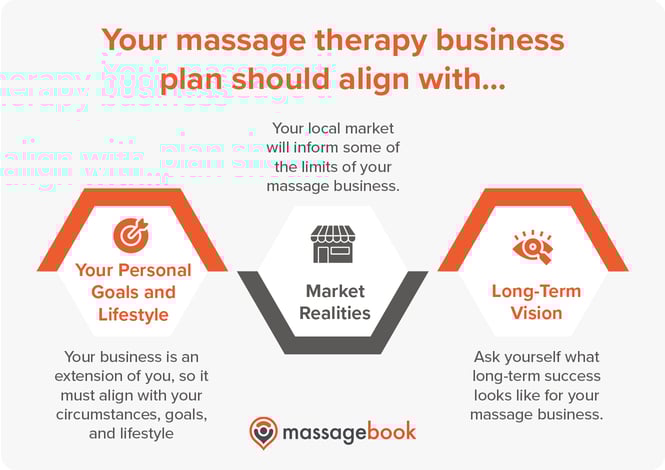
- Your personal goals and lifestyle: YA sustainable plan must account for your physical limits and time availability. If you are a solo practitioner with a cap of five sessions a day or a part-time owner, your financial goals must reflect that reality to prevent burnout.
- Local market realities: Your local market will inform some of the limits of your massage business. Perform a competitive audit to ensure your pricing and service menu align with local demand. If the neighborhood average for a 60-minute session is $90, a plan built on $150 sessions needs a massive differentiation strategy to be viable.
- Long-term vision: Define your long-term goal early. Are you building a solo practice or a multi-therapist team? Your business plan should explicitly state whether you intend to hire other bodyworkers, sell the practice in five years, or eventually franchise your model.
Don’t forget to consider the bigger picture by also determining why you’re starting a massage practice and what values drive your work. That way, people who read your plan have a holistic understanding of your business.
How do I define my niche in a business plan?
To define your niche, identify an underserved group in your local market and match their specific needs to your preferred services, such as sports recovery or prenatal care. Then, use your massage therapy business plan to outline how your specialized services provide a unique solution that generalist competitors overlook. Focus on the intersection of your professional expertise and local demand to ensure your brand stands out and attracts a loyal client base.
How do I calculate startup costs for a massage therapy practice?
Calculate your startup costs by totaling your one-time launch capital and a six-month operating reserve. Your budget must include these categories:
- Space and legal: Security deposit, business license, insurance, and permits
- Equipment: Professional table, bolsters, stool, and initial linen sets
- Supplies: Bulk oils, lotions, cleaning supplies, and decor
- Technology: Scheduling software, devices, and a POS system
- Marketing: Website launch, signage, and initial ad spend
How long should my massage business plan be?
The more complex your massage business, the longer your business plan will need to be. Use these general benchmarks to decide:
- 1 page: Best for solo practitioners or mobile therapists
- 10–15 pages: Ideal for dedicated studio owners and small teams
- 20+ pages: Required if you are seeking a bank loan or outside investors
Ultimately, the more people who are involved in your massage practice or the more you’ll charge for your services, the more likely you’ll need a longer business plan.
How often should I update my massage business plan?
A massage therapy business plan isn’t a static document, but rather a living resource that should grow and change with your massage practice. We recommend revisiting and updating your business plan regularly to ensure its details are still accurate and applicable, even after getting your business off the ground. Generally, this means making updates every 6-12 months, or whenever your goals shift or any other large business changes occur.

7 essential sections in a massage therapy business plan
A professional massage therapy business plan serves as the blueprint for your practice. While every document is unique, most effective plans are built around these seven essential pillars:
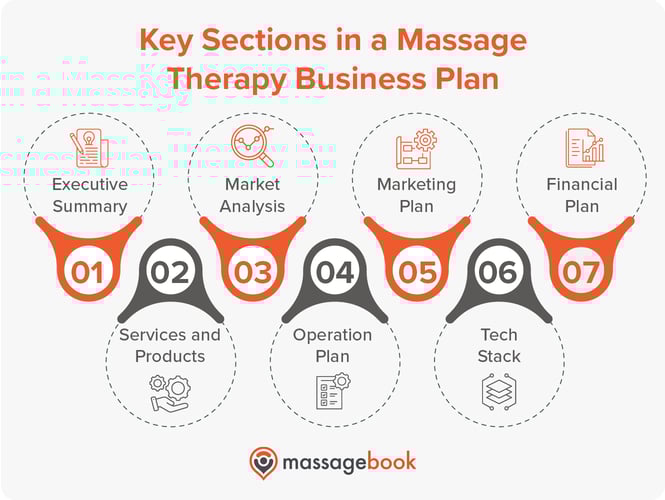
- Executive summary: Your mission, ownership structure, overarching goals, and other high-level details
- Services and products: Services, products, pricing, and recurring revenue models
- Market analysis: Local demand, competitor research, client personas, and niche
- Operational plan: Daily workflows, equipment, staffing, and risk management
- Marketing plan: Brand strategy, target audience, acquisition channels, and success metrics
- Tech stack: Software for scheduling, digital SOAP notes, payments, website, and other core areas
- Financial plan: Revenue milestones, expense projections, cash flow forecast, and funding requirements
Let’s explore a detailed breakdown of each of these sections, so you can use them to create a high-impact massage therapy business plan.
Executive summary
This section summarizes your business plan and highlights the most important details. Generally, it includes:
- Company description: This is a concise summary of your business’s model, location, niche, and offerings. Individuals who read your massage therapy plan should have a general idea of what your business looks like just from reading this description.
- Ownership structure: Is your massage practice a sole proprietorship, limited liability company (LLC), partnership, or something else? This is important to note as it affects your massage practice’s taxes, legal liability, ownership rights, and more.
- Business objectives and goals: This section will discuss your business’s core mission and goals.
- Financial projections: Here, you’ll briefly summarize your massage business’s financial projections. You’ll have an opportunity to dive into this topic more in-depth later in your business plan, so this should just be a high-level overview.
- Funding requirements: If you need additional funding to launch your massage business, summarize your needs here and the types of entities you may seek funding from.
Services and products
In this part of your massage therapy business plan, you’ll discuss the details of the services and products you plan to offer. This section usually includes the following details:
- Services: Write down every service you offer, what it entails, and the benefit it provides to the recipient. For example, if you offer Swedish massage, your description might look like this: “A massage technique that focuses on relaxation and improving circulation. It involves percussion, kneading, vibration, tapping, and rolling to help recipients relieve physical tension or pain, promote blood circulation, and unwind.”
- Products: Many massage therapists sell products that they use, as clients may ask about them after their session. Describe these products as well, including what they are, what they do, and why clients might purchase them. Common items include massage lotion, essential oils, bath salts, foam rollers, home massage tools, and gift cards.
- Price: Alongside the description of each service and product, you should also list the price you plan to charge for them. If you offer memberships or service packages, include the discounted rates for any services or products included in those options.
- Memberships or packages: Memberships and packages are popular ways for massage therapists to acquire more sustainable and predictable revenue. List the memberships and packages you plan to offer, what they will include, and how much they cost. For instance, your membership might be $120 per month and include one 60-minute massage per month, and perks like priority booking or a 10% discount on other services.
Market analysis
The competitive analysis section of your massage therapy business plan is where you’ll note all your market research. This section shows that you’ve done the work to make sure that your massage business has a market (plenty of customers to sustain you financially). This is great both for your own self-confidence and to demonstrate to funders that your business has the potential to be profitable.
This section should contain your research into your:
- Market demand: Assess the market demand for massages in the area you plan to operate. This might mean surveying community members, researching local search trends, asking other local professionals, or even running a small test by offering short massage sessions in a community shared space.
- Customers: Once you’ve established a demand for your services, outline personas for your ideal customers. This should include demographic details, primary motivations and values, their booking behavior, spending habits, and ideal massage experience. Ideally, your massage business will have two to four core customer personas.
- Competitors: Next, you need to assess your competitors in the space. Research other massage businesses in your area. Look at what services or products they offer, how much they cost, and the number of clients they serve per week. Assess their strategy for gaps and consider how you can leverage those gaps to your advantage. Or, check for what they’re doing well and apply those best practices to your massage business. In particular, note whether the massage market is over- or undersaturated in your area, as that may determine whether opening a profitable massage practice is feasible.
- Niche: With the information you’ve gleaned about your ideal customers and your competitors, you can set a niche for your practice that makes you stand out from the other massage businesses in your area. For instance, if you enjoy giving deep tissue and sports massages and there are many gyms and fitness buffs in the area, you might open a massage practice geared toward sports, such as pre-event, post-event, and recovery massages.
Operation plan
This portion of your massage therapy business plan will go over details of your business operations, such as:
- Daily operations: Discuss how you’ll run your business day-to-day. For most massage businesses, this will include some combination of providing massages, taking SOAP notes, handling scheduling and billing, and marketing the business.
- Equipment and inventory: Note all the equipment you’ll need to run your massage business successfully, such as a massage table, lotions and oils, linens, and pillows. If you plan on stocking products, you can reiterate those here as well.
- Staffing and compensation: Massage practices that employ multiple staff members (either to handle administrative work or to serve as other massage therapists) should detail how many employees they’ll bring on, employees’ roles, and compensation details.
- Risk management: Operating any form of business comes with an inherent risk. However, this risk is multiplied for massage practices since their offerings involve bodywork, and being prepared can help you avoid unnecessary consequences. Note how you’ll mitigate them, such as by purchasing liability insurance, staying compliant with local and federal massage regulations and permitting, documenting all client encounters extensively with SOAP notes, and sanitizing all equipment and using new linens for each new client.
Marketing plan
Offering stellar massages is key, but before that, customers need a way to discover your massage business. The marketing section of your massage therapy business plan will address that by covering:
- Brand and value proposition: Describe what sets your massage practice apart from all others, which you will highlight in your marketing communications. Americans see around 5,000 ads per day, so you need to make your messages count, and your value proposition is a great way to do that.
- Target audience: You’ve already described your target audience and customer personas in the competitive analysis section. Briefly summarize those personas here again, but spend more time discussing their marketing preferences and buying behavior. For example, what marketing channels do they frequent? What type of messaging will inspire them to convert?
- Marketing strategies: Using the information above, set your massage marketing strategy. Determine which channels you’ll focus on (website, email, social media, etc.), what types of messages you’ll send (educational, promotional, or a mix), retention and loyalty strategies (such as follow-up messages or a dedicated loyalty program), and what your marketing cadence will look like on a week-to-week basis.
- Marketing metrics: Establish metrics to track early on to make it easy for you to evaluate your marketing success. These might include conversion rate, website traffic, social media follower growth and engagement rates, email open rate and clickthrough rate, review volume, and average rating.
Tech stack
Investing in the right technical tools can set your massage business up for success. In this section, you’ll discuss:
- What software you’ll purchase to support your business
- What key features and capabilities it provides
- How much the software costs
Instead of purchasing a few discrete tools that may or may not integrate, we recommend choosing a comprehensive solution that grows with your business. Look for software that includes the following features:
- Scheduling and appointments
- Client intake forms
- Digital payments
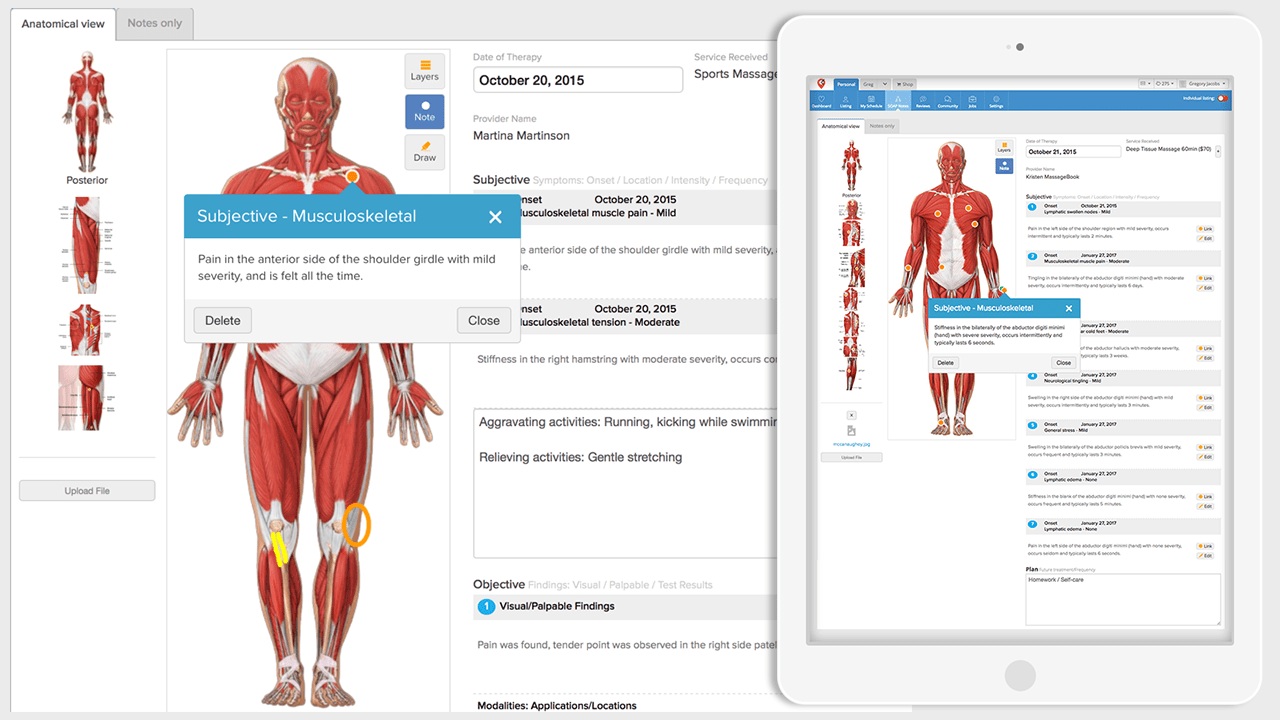
- SOAP notes
- Client database
- Website builder and integrations
- Marketing automation
- Memberships
- Reviews and testimonials
- Data and analytics
Financial plan
No massage therapy business plan is complete without a discussion of finances. In this section, you’ll cover details such as:
- Revenue projections: Based on the market research you’ve conducted, provide your estimates for the revenue milestones you’ll achieve within the first few years of operation.
- Expense projections: Estimate the expenses associated with starting and running your massage business for the first few years of operation. Ideally, the value of your expenses should be lower than the revenue you bring in.
- Cash flow forecast and analysis: Proper cash flow contributes to a business’s financial stability and ensures it has enough liquid funds to cover its operating expenses. Conduct a cash flow forecast and analysis to ensure that your massage practice will have enough liquid funds to cover its financial obligations in a timely manner.
- Funding requirements: You likely touched on this in your massage therapy business plan’s executive summary, but this is the place to discuss it in-depth. Outline how much funding you’ll need to support your business and a few different funders you may seek funding from. If you’re submitting this business plan to a potential funder, you can omit the latter details.
Massage therapy business plan template
Feeling overwhelmed by the idea of completing a massage therapy business plan? Don’t worry, plenty of massage therapists have felt the same. That’s why we’re providing a quick business plan template you can use to guide your first draft!
Executive summary
Business objectives
[Massage business name] is a legal entity organized under the laws of [State/Country] and operates as a [legal structure, such as sole proprietorship, LLC, etc.]. The business specializes in providing professional massage therapy services to [brief description of target audience] focused on [briefly discuss goal of services].
Ownership structure
[Massage business name] operates as a [legal structure, such as sole proprietorship, LLC, etc.], established in accordance with all relevant legal provisions. [Detail the percentage of ownership by each involved individual or any other relevant details to your ownership structure.]
Financial projections
Our financial projections indicate that [massage business name] anticipates [describe your financial projections over the next few years. For example, “steady growth in revenue over the next five years.”] These projections are based on realistic assessments of market demand, pricing strategies, cash flow analysis, and expenses, all in accordance with applicable financial regulations.
Funding requirements
If this massage therapy plan is for your own reference, you can follow this template:
Based on our financial projections, [massage business name] will be seeking [funding amount] to support business growth and expansion. [Massage business name] may seek financing through business loans, grants, or investment agreements as necessary, while adhering to all relevant financial regulations.
If you are sending this massage therapy business plan to a potential funder, you can follow this template instead:
Based on our financial projections, [massage business name] will be seeking [funding amount] to support business growth and expansion. Any financing will adhere to all relevant financial regulations.
Services and products
Services
|
Massage Service |
Description |
Benefits |
Price |
Membership Price |
Package Price |
|
[Add the name of the massage service in this column] |
[Add a description of the massage service and what it entails.] |
[Describe the benefit the service provides to the recipient. |
[Add the price of the service. If you plan to price services differently based on duration, add that here as well.] |
[If prices for members are discounted, add the discounted prices here.] |
[If you offer discounted services in packages, add the prices here.] |
Products
|
Product |
Description |
Benefits |
Price |
Membership Price |
Package Price |
|
[Add the name of the product in this column] |
[Add a description of the product and what it does.] |
[Describe the benefit the product provides to the recipient. |
[Add the price of the product.] |
[If prices for members are discounted, add the discounted prices here.] |
[If you offer discounted products in packages, add the prices here.] |
Memberships and Packages
|
Membership/Package Name |
Price |
Included Services/Products |
Other Perks |
|
[Add the name or other defining feature of the membership/package in this column.] |
[Add the price of membership or package. If you offer different prices monthly or annually, note them as well.] |
[Detail what services or products are included in the membership or package.] |
[If memberships or packages come with other perks, add them here.] |
Market analysis
Market demand
[Summarize your research into the demand for massage services in your local market.]
Target customers
Based on our research, our target customers fall into these general personas:
Fill out the following list for each persona.
- Name:
- Age range:
- Gender:
- Occupation and income:
- Family status:
- Location:
- Primary motivations/goals:
- Values:
- Spending habits:
- Booking behavior:
- Ideal experience:
- Other relevant details:
Competitors
Our main competitors in the space include:
Fill out the following list for each competitor:
- Business name:
- Offerings:
- Pricing:
- Clientele:
[After filling out this list for each competitor, write a paragraph summarizing the gaps in their strategy that your business can fill.]
Operation plan
Daily operations
[Describe what daily operations look like at your business.]
Equipment and inventory
[Massage business name] will purchase and maintain the following equipment to safely and effectively provide massage therapy services:
[List all the equipment you will need.]
Staffing
If you plan on hiring additional staff members, fill out this section. Otherwise, skip it.
[Massage business name] will bring on [number] of additional staff members to fulfill core business functions, including [business operations that these staff members will handle]. All staff members shall be duly licensed, certified, and trained as necessary and per the legal requirements set forth by [state or country your massage business is operating in].
Risk management
To mitigate any foreseeable risks, [massage business name] will purchase and maintain insurance coverage, including [list the types of insurance you plan to purchase. This generally includes professional liability, general liability, and workers’ compensation insurance.]. Our massage therapists will also maintain standardized encounter documentation (SOAP notes) and stay compliant with any other relevant local or federal regulations.
Marketing plan
Brand and value proposition
Our marketing messages will focus on the following brand and value proposition: [detail your massage business’s brand and value proposition. Focus on how this differentiates you from your competitors.].
Target audience
[Summarize your customer personas in this section, focusing on how they interact with marketing messages.]
Marketing strategies
[Discuss what marketing channels you’ll focus on, the types of messages you’ll send, what your marketing cadence will look like weekly, and any retention and loyalty strategies you’ll implement.]
Metrics for success
[Discuss what metrics you will track to measure the success of your marketing efforts and how you will track them.]
Tech stack
To better facilitate business establishment, growth, and expansion, [massage business name] will purchase the following software solutions:
[Name the solutions you will purchase, the key features you’re interested in, and how much it will cost to implement and continue using.]
Financial plan
Revenue projections
[Massage business name] anticipates achieving the following revenue milestones:
- Year 1: [Year 1 revenue projection]
- Year 2: [Year 2 revenue projection]
- Year 3: [Year 3 revenue projection]
- Year 4: [Year 4 revenue projection]
- Year 5: [Year 5 revenue projection]
[If you have any visuals of your revenue projections, such as a graph, you can add them in this section.]
Expense projections
[Massage business name] anticipates the following expenses in each year, including but not limited to operating costs, marketing expenses, lease payments, and other overhead expenses.
- Year 1: [Year 1 expense projection]
- Year 2: [Year 2 expense projection]
- Year 3: [Year 3 expense projection]
- Year 4: [Year 4 expense projection]
- Year 5: [Year 5 expense projection]
[If you have any visuals of your expense projections, such as a graph, you can add them in this section.]
Cash flow forecast and analysis
We’ve conducted a comprehensive cash flow forecast and analysis to ensure that [massage business name] will be able to manage its financial obligations in a timely manner. This analysis considers projected cash flow inflows and outflows, including accounts receivable, accounts payable, and debt service.
[Add details of your cash flow forecast and analysis here. If you have any useful visuals, such as a graph, you can also add them to this section.]
Funding requirements
If this massage therapy plan is for your own reference, you can follow this template:
Based on our financial projections, [massage business name] will seek [funding amount] to support business growth and expansion. [Massage business name] may seek financing through business loans, grants, or investment agreements as necessary, while adhering to all relevant financial regulations.
If you are sending this massage therapy business plan to a potential funder, you can follow this template instead:
Based on our financial projections, [massage business name] will seek [funding amount] to support business growth and expansion. This funding will allow us to [detail what exactly the funding will help with, such as startup costs, lease costs, etc.]. Any financing will adhere to all relevant financial regulations.
Additional resources
A massage therapy business plan is one of the most important documents you will put together for your practice. With it, you’ll be well-informed about the demands of starting and running your massage business, enabling you to make smart business decisions. Plus, when you share the document with potential funders or investors, you show your credibility and legitimacy, which may lead to more funding opportunities.
Don’t forget to support your new massage business with robust software. Look for a comprehensive solution like MassageBook to assist with all areas of your practice’s operations. Our tools are designed by massage therapists for massage therapists, making MassageBook your ultimate partner!
Interested in learning more about running a massage business? Explore these resources:
- Massage Therapy Marketing: 15 Effective Ideas to Explore — Getting the word out to clients is a pain point for many independent massage practices. Discover top massage marketing ideas here.
- A Guide to Massage Billing: Insurance Codes for Therapists — Did you know that your massage practice can accept medical insurance? Learn the benefits and drawbacks of taking this approach.
- 13 Best Massage Therapy Software Solutions — The best massage therapy software solutions make it easier to handle all of your tasks. Explore the top solutions in this guide.