Contents
This guide breaks down the bookkeeping process into manageable steps to help you build a strong financial foundation for your massage therapy business. By investing your time in understanding your numbers now, you’ll be able to create sustainable financial systems that simplify the process well into the future.
 Step 1: Start with the right bookkeeping tools for massage therapists
While it may seem counterintuitive, choosing the platform you’ll use to manage your finances will inform the steps you must take to create a bookkeeping process that works for your massage practice. However, what makes this difficult is the sheer number of options available, from specialized financial apps to massage therapy software with bookkeeping functionality.
The ideal platform will fit your operations, business style, and financial goals. It should make it easy for you to track finances, stay on top of taxes, and pull reports featuring real-time data so you can make smarter business decisions.
If you’re not sure where to start, here are a few options for you:
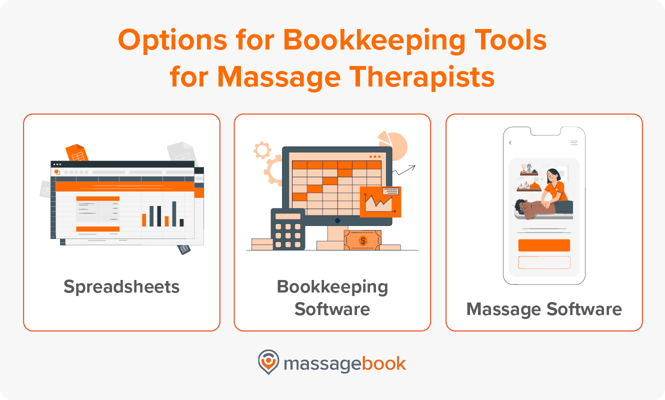
1. Spreadsheets
If you’re frustrated with managing a pen and paper system, Microsoft Excel or Google Sheets is a fine place to start. Spreadsheets make it easy to organize your finances in a way that makes sense to you, especially if you know how to personalize layouts and add advanced formulas. These tools help you become more mindful of your financial tracking.
However, this approach comes with a few drawbacks. For example, you have to back up your spreadsheets to ensure you don’t lose any information. This process is also highly manual, so you may encounter more errors and have to spend more time managing your sheets.
2. Bookkeeping software
With bookkeeping software, such as QuickBooks and FreshBooks, you can utilize cloud-based services to manage your finances and handle other, more complex tasks. These solutions enable you to track all financial transactions, including accounts payable and receivable, and reconcile your financial records with your bank statements. They simplify tax preparation by maintaining organized financial records and mitigating human error.
The downside of bookkeeping software is that it costs more money than using spreadsheets, and it may be more complex than you need. You may also have difficulty integrating a bookkeeping solution with your other software tools.
3. Massage software
Many all-in-one massage therapy software solutions include the bookkeeping features that massage practices need. For instance, MassageBook is expressly designed to help massage therapists run their practice efficiently so they can focus on offering their clients the best possible service. In one centralized platform, the app makes it easy to:
- Bill clients
- Manage bookings
- Track expenses
- Add digital SOAP notes
- Track sales activity
- Run financial reports
With a massage therapy solution, you won’t have to worry about integrations or overpaying for bookkeeping features you don’t need. When you work with MassageBook, you can feel confident knowing that you’re using a solution designed by massage therapists, for massage therapists.

Step 2: Track every dollar in and out
Knowing your massage business's financials is key. At the end of the day, there are two things you have to track to manage your money meaningfully: money in and money out.
Tracking your massage practice’s income
Tracking income can be easy if you use the same platform for managing invoices and client payments.
Take the time to learn your platform inside and out—after all, you are using it to manage your livelihood. Don't hesitate to use the support team for a full tour, and do some exploration on your own as well. Check out your dashboard, try out different features, create a sample invoice, edit it, and then learn how to delete it.
If you make a version of the invoice to send to yourself, you can see what it looks like on your client's end. You'll also be able to see how their payment options work. This is useful if you ever need to guide your client through the online payment process.
Your platform should also provide easy-to-read income reports. If you're using MassageBook, you can view your revenue instantly by selecting the "Sales" tab and clicking "Income." From there, simply use the date drop-down menus to adjust the time frame you want to review.
Tracking your massage practice’s expenses
Likewise, tracking your spending these days is pretty easy, especially with a business bank account or credit card. Simply use your card for all of your transactions, and you'll be able to access them through most banking apps.
However, this only gets you so far; some apps can be difficult to navigate or don't offer a way to pull up all of your transactions at once.
We recommend that you take the time to actually track your expenses in a separate platform (or spreadsheets). You can do this during your weekly finance meeting with yourself (more on that later). Go ahead and note all of your expenses for the week. Most of the platforms you'll use for invoicing (MassageBooks, Freshbooks) will include a way to track expenses.
What is a business expense? Pretty much anything you spend money on for your business. While tax professionals may have a precise definition for this (please consult with a professional if you have any questions), these include:
- Physical items like massage oils, linens, supplies, equipment, office space
- Continuing education related to your field or business
- Marketing expenses
- Website hosting
- Professional memberships
- Insurance
As you track your transactions, note which ones are tax-deductible so that you can claim them once tax season arrives.
One way to make it easier for yourself to track expenses is to stick with a handful of good vendors rather than trying to shop around for everything. You don't have to do this, but it might help. It sure doesn't hurt to build up good relationships with your vendors as a good business practice.
By getting good at tracking both your expenses and your income, you'll start to pick up on trends, plan expenses better, and avoid potential surprises. Trust us—the tracking process gets easier over time.
Bookkeeping tip: Keep your personal and business accounts separate
Another crucial step for running your business successfully, especially when it comes to accounting, is ensuring you have a separate personal and business checking account.
These shouldn't be intermingled. By keeping things separate, you don't have to worry about keeping track of business versus personal expenses. It's not fun, and it could lead to audit trouble in the future!
If you need to open a business account, try to avoid ones with hefty, unnecessary fees. Once you've narrowed it down to a few options, call each bank to learn your accounts fees and perks.
You can even waive some fees by asking nicely. If they give you pushback, just explain you're deciding where to bring your business, and want the best they have to offer. Otherwise, just go elsewhere. It may or may not work, but it's worth a shot.
By using your business bank account or a business credit card for business expenses, it's much easier to track all of your transactions in one place.
If you do need to use cash for a transaction, note it down somewhere safe and keep the receipt. We recommend getting into the habit of snapping a quick picture of every receipt with your phone. Just make sure you remember to include it when calculating your expenses for the week. We'll cover a process for setting up a weekly financial review for yourself in step 6.
Step 3: Stay on top of your taxes
To avoid panic during tax season, you must understand your obligations regarding income tax, self-employment tax, and state/local taxes. While we highly recommend consulting a tax professional if you are new to business ownership, here are four strategies to help you stay on top of your obligations:
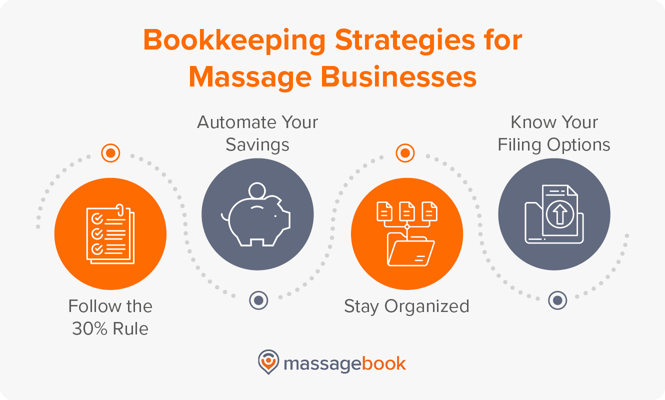
- Follow the 30% rule: Aim to set aside 30% of your income into a separate high-yield savings account. While conservative, this ensures you won't have to scramble for funds when quarterly payments are due. If you end up owing less, treat the surplus as a year-end bonus or reinvest it in your business.
- Automate your savings: Check if your bank allows automatic transfers. Scheduling a recurring transfer to your tax savings account removes the manual effort and ensures consistency.
- Stay organized: Keep all receipts, bills, invoices, and past tax forms in one central, organized location throughout the year.
- Know your filing options: If your finances are straightforward, self-filing software like TurboTax or FreeTaxUSA can be a great way to save money and learn the mechanics of your business finances. However, if your situation is complex, hiring a CPA is the safest route.
Please note that MassageBook does not provide legal or tax advice. The information above is for educational purposes only. For personalized advice, please consult a qualified tax professional or accountant.
Step 4: Know your numbers for smarter business decisions
Bookkeeping can be a stressful topic to discuss as a business owner. However, if you can get a handle on your numbers, you can reframe them in your mind as a business-growing tool.
With better control over your numbers, you can get new insights into your cash flow, optimize expenses, and make small changes to your finances that make big differences.
For example, if you know that March through May tend to be your slower months, you can mitigate your loss with a little bit of action. You could plan to:
- Increase your marketing efforts
- Run special promotions
- Set aside extra money during the more fruitful months
Over time, you'll naturally discover your break-even point as you track your income and expenses. This is where your income exceeds your expenses. Once you have this number, you can start to set financial goals for your business. Maybe you want to save up for upgraded equipment, an upcoming convention, or investing in continued education.
The mere act of setting up a financial goal signifies that your business is healthy and that you're taking a mindful approach to your finances! The best financial goals are specific and realistic. For example, the goal shouldn't be "make more money." Of course, it's okay to want that, but your goal should have a dollar amount attached.
A better example might be, "I will make an extra $1000 this month," or "I will double my income by November." It's also essential to keep it realistic so that the goal isn't so big that you don't take action to pursue it.
Take a moment right now to think of a goal worth pursuing. If you want to make an extra $1000 per month, what are some ways you could tweak your numbers to engineer your way there? What steps could you take today or this week? These are questions you couldn't meaningfully answer without tracking and knowing your numbers.
Setting goals can be a fun way to gamify your business. You can set them up, break them down into smaller goals, and celebrate each time you hit them.

Step 5: Automate and simplify bookkeeping where possible
Automation can help simplify and almost error-proof your systems. With the right arrangement, you can set your apps up to integrate with each other and remove most of the manual labor.
The first four steps were dedicated to learning and leveraging your numbers. The next step is to make it even easier for you to stick to your systems. This way, reaching your financial goals will happen in the background while you continue to spend your time and attention where you need to most—your clients.
Using your bookkeeping software to your advantage
Leverage the tools that are available to you. Most of the platforms that allow you to track your finances also allow you to automate your processes. Feel free to reach out to support and ask them to specifically walk you through automation features.
Apps like MassageBook are multi-functional, allowing you to track income, integrate with other platforms, bill clients, and manage appointments (to name a few). The platform will walk you through any new functions that you want to set up (like adding clients to your list, creating SOAP notes, or even sending out email campaigns). However, if you can't find what you're looking for, our support team is always happy to help guide you.
Regardless of the app you're using, ensure you're utilizing all its features.
Set up autopay wherever you can
Automate what you can to save yourself from having to spend so much time manually sending payments. Most places allow you to set up automatic payments online, such as for your rent, insurance, utilities, and other expenses. If you're paying rent to an older institution that doesn't use online payments, most banks allow you to set up bill payments to send directly from your bank.
Use automation to reach your financial goals, as well. You can also set up automatic transfers (like we mentioned earlier in the tax section) that send a specific amount of money at a set frequency, such as $500 every two weeks.
If you decide to set a savings goal of $10,000 in the next five months, you can set up automatic transfers of $2,000 every month, $1,000 every two weeks, or $500 every week (you get the idea).
Step 6: Create a bookkeeping check-in routine
The next step is to schedule a weekly (and monthly) check-in with yourself to review your finances and systems. We recommend this for a few reasons.
First of all, this gives you time to sit down and make sure your systems are running smoothly. It also allows you to identify any potential areas of concern, errors, or disconnects where things should be connected.
Take this time to reconcile your income and your expenses. Ensure that your bank accounts are accurate, and record any tax-deductible expenses for your tax records.
Scheduling your weekly bookkeeping check-in
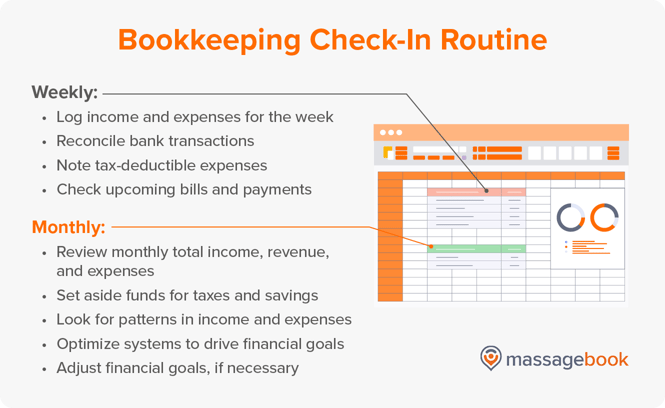
Schedule your weekly check-ins on your calendar. Stick to this routine like you're keeping a doctor's appointment or a flight. For weekly check-ins, you can:
- Log your income and expenses for the week
- Reconcile bank transactions
- Note your tax-deductible expenses
- Check upcoming bills and payments
You can also take this time to make any adjustments to your current business approach. Do you need to adjust for the additional equipment you purchased this week? Did you account for the additional income from your newest clients?
Scheduling your monthly bookkeeping check-in
Then, there's your monthly check-in. Take time to hold a longer review at the end of each month to have a closer look at all of your overarching goals and major adjustments that need to be made. While this is essentially going to be a longer, more in-depth version of your weekly check-ins, this will focus on:
- Reviewing your monthly total income, revenue, and expenses.
- Setting aside funds for your taxes and savings
- Looking for patterns in your income or expenses
- Optimizing your systems to drive your financial goals
- Adjusting your financial goals, if needed
Building these check-ins into your schedule will help you stay on top of your systems and develop better financial habits.
Plus, these regular reviews will become a natural part of your business rather than an overwhelming chore. This will make you more confident in your financial management skills and help you maintain your financial stability.
Additional resources
Bookkeeping is crucial for running a healthy and thriving massage business. The more attention you can pay to it, the more empowered you’ll feel with each financial decision. Over time, you’ll know exactly how to make adjustments, prepare for your taxes, and set (and reach) meaningful, achievable financial goals. Just be sure to choose a software solution that helps you do that!
Want to learn more about growing a thriving massage practice? Check out the following resources:
- 10+ Best Massage Therapy Software Solutions — Running a massage therapy business can be quite stressful. Streamline your administrative work with dedicated massage therapy software.
- A Guide to Massage Billing: Insurance Codes for Therapists — Massage practices have the option of accepting insurance for their services. Explore the pros and cons of this strategy and how you can implement it in your business.
- How to Write a Massage Therapy Business Plan + Template — A massage therapy business plan is a comprehensive document that outlines your goals and how you’ll achieve them. Learn how to write a thorough business plan in this guide.