Contents
Improving search visibility means leveraging search engine optimization (SEO). This guide contains everything you need to know to get your massage practice ranking on search engines.
The definition of massage therapist SEO
Search engine optimization, also known as SEO, is the process of improving your website’s visibility on search engines like Google and Bing. Unlike paid advertising, where you pay for every click or view, SEO focuses on organic visibility. It’s about earning your spot at the top of the search results by proving to search engines that your website is the most relevant, trustworthy, and helpful answer to a potential client's query.
Local SEO for massage therapy
Standard SEO is often used by individuals and businesses trying to reach a national or global audience. Local SEO, however, focuses on capturing clients in your specific geographic area.
Because massage therapy services require you and your client to be in the same physical location, your clients are inherently local. Local SEO optimizes your presence for searches like “near me” (e.g., “massage near me”) and location-specific searches (e.g., “sports massage in Seattle”).
The foundation of SEO: A strong website
Ensure your website is technically sound before implementing SEO best practices. If your site is broken, slow, or hard for search engines to read, no amount of clever SEO will get you to the top of search engine results pages (SERPs).
To ensure your website is ready to support your SEO strategies, focus on these technical pillars:
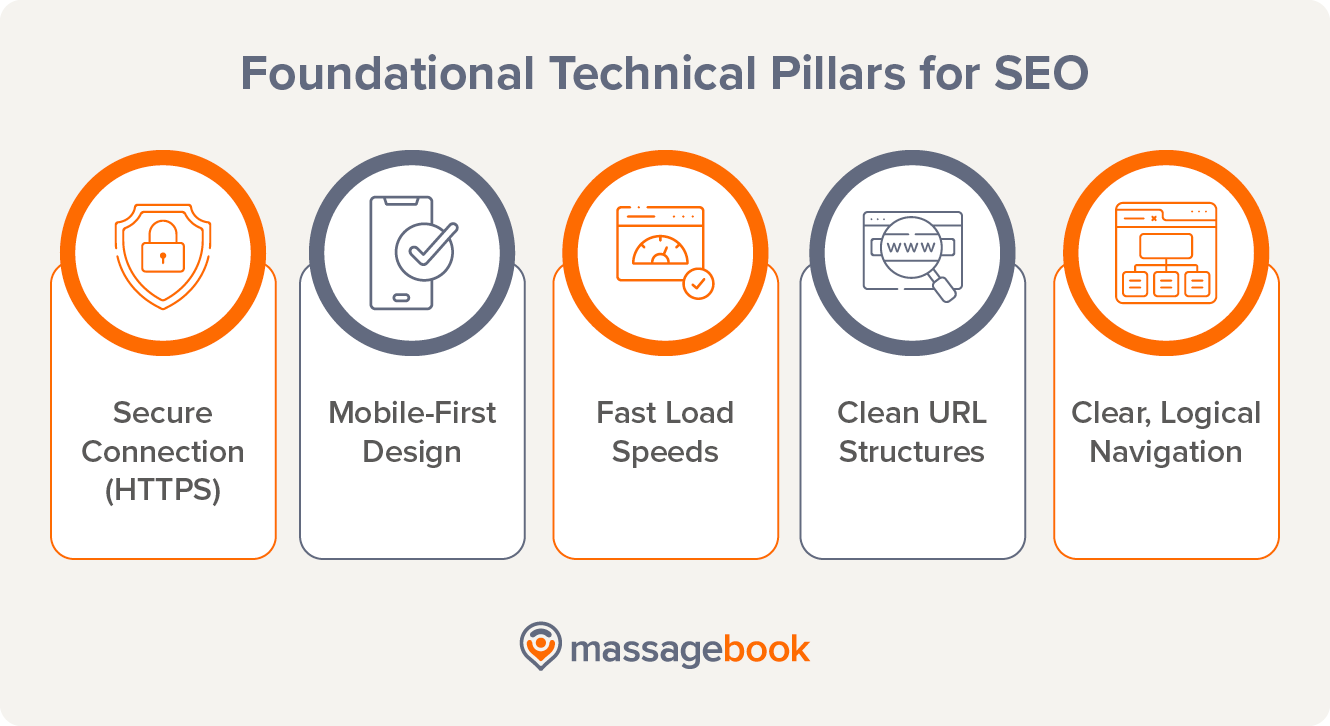
- A secure connection (HTTPS): Look at your website’s URL. If it says "HTTP" instead of "HTTPS" (or lacks a little padlock icon in the browser bar), Google will flag your site as not secure. Purchasing an SSL certificate from your web host is a mandatory first step for establishing digital trust.
- Mobile-first design: Google uses mobile-first indexing, meaning it primarily looks at the mobile version of your site to determine rankings. If your website requires zooming, pinching, or side-scrolling on a smartphone, search engines will be less likely to rank it highly.
- Fast load speeds: A frustrated client won't wait more than a few seconds for a page to load before hitting the back button. Search engines track this sort of behavior under the bounce rate metric, which is the number of people who quickly leave a site without taking any action. Keep your site’s load speeds fast by compressing large images (like high-res photos of your treatment room) and avoiding unnecessary plugins.
- Clean URL structures: Your web addresses should be readable by humans and web crawlers alike to give them a good idea of what the page is about. For example, a URL like https://yourpractice.com/page?id=3958 doesn’t tell search engines or visitors anything about the page, whereas a URL like https://yourpractice.com/sports-massage communicates that the page is about sports massage.
- Clear, logical navigation: Search engine crawlers need to be able to easily read your site to understand your practice. Organize your pages logically. A clean hierarchy usually looks like this: Home > Services > Specific Modality (e.g., Deep Tissue).
Taking care of these core technical elements ensures search engines can crawl, index, and evaluate your content. Once your site is stable and accessible, you can focus on specific strategies that will actively drive local clients to your practice.
Top local SEO strategies for massage therapists
Now that you understand the basics of massage therapist SEO, let’s take a look at the top strategies you can employ on your website.
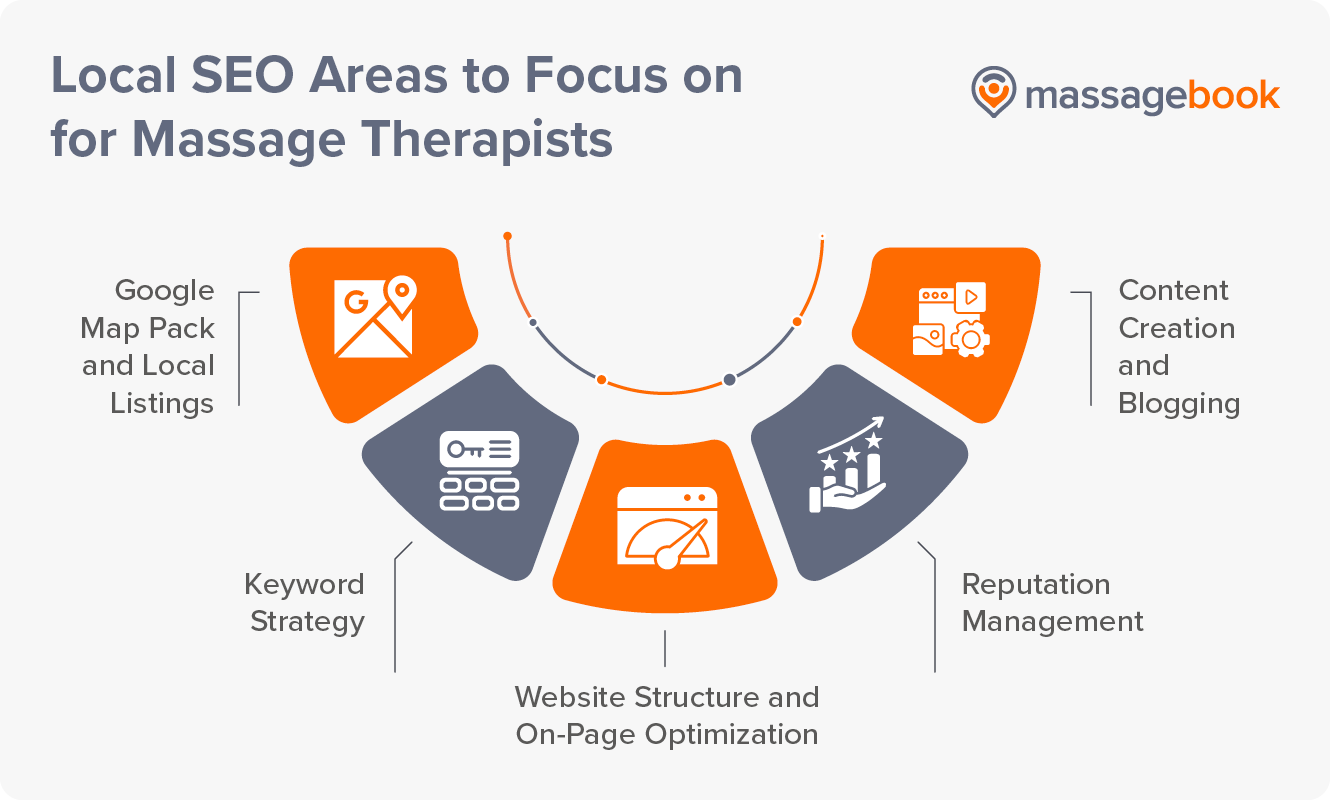
Google Map Pack and local listings
When local clients search for massage therapy, the first thing they see isn't standard website links. It's Google's map recommendations, otherwise known as the Google Map Pack or Local Pack. Here is what the Map Pack would look like if you searched “massage therapist in Chicago”.
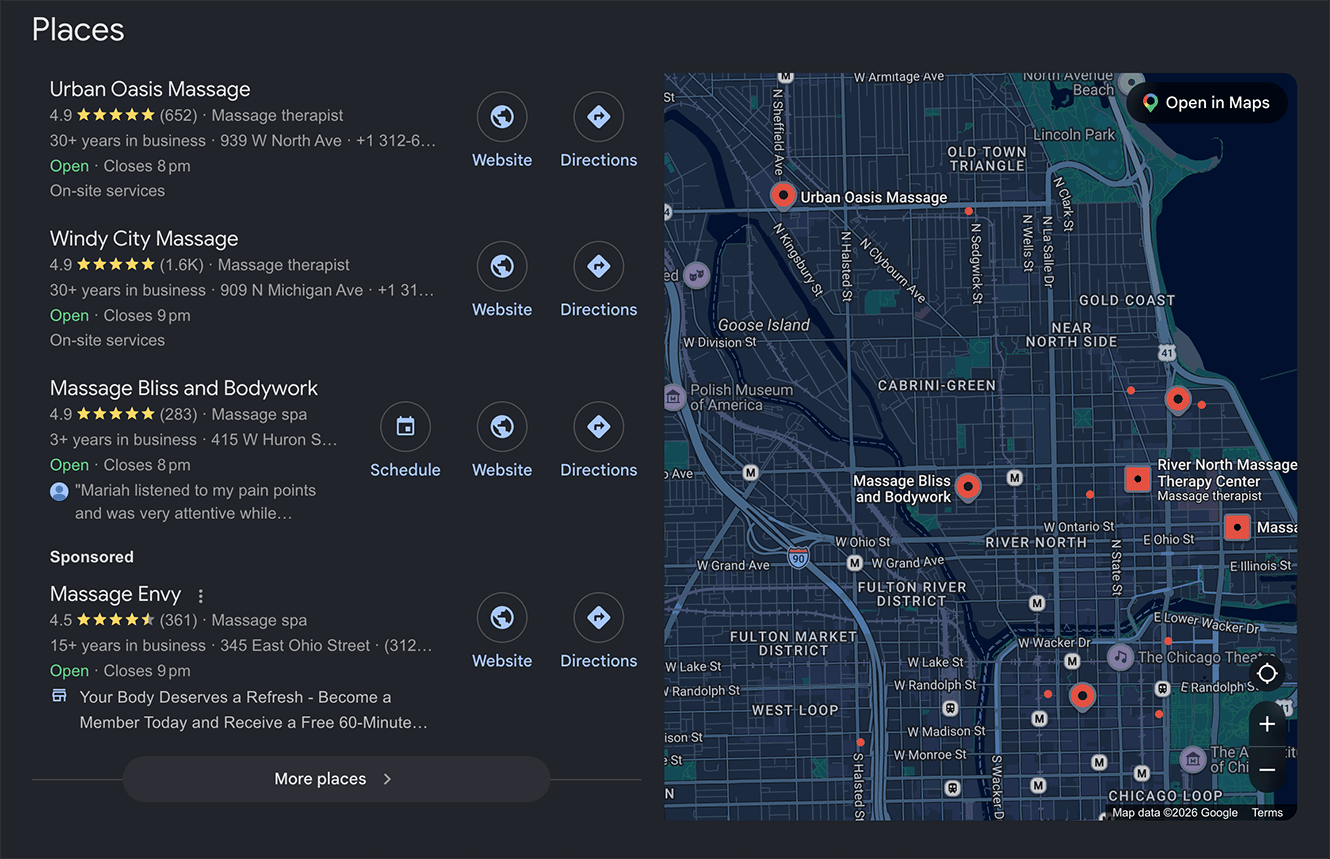
Appearing in these map results and local business directories is one of the fastest ways your practice can gain visibility among clients ready to book.
Here are a few ways you can optimize your website for the Google Map Pack and local listings:
- Claim and optimize your Google Business Profile (GBP): This is the engine that powers Google Map Pack. Claim your profile, fill out every field, select the correct primary category, upload high-quality photos of your treatment room, and list your business hours.
- Ensure NAP consistency across platforms: NAP stands for Name, Address, and Phone number. Ensure that your massage practice’s NAP appears exactly the same across the internet (including your website, social media profiles, and business directory listings) to avoid confusing search engines and customers alike.
- List your practice in local directories: Ensure you are listed on Yelp, the local Chamber of Commerce, and industry-specific directories (such as the MassageBook directory).
- Claim your Apple Business Connect profile: Millions of iPhone users default to Siri and Apple Maps to find local services rather than searching via Google. Setting up a free Apple Business Connect profile lets you customize how your massage practice appears across the iOS ecosystem, helping capture potential clients who may never even open a web browser.

Keyword strategy
Keywords are the exact words and phrases users type into search engines when they have a query. For massage practices, this is what prospective clients search for when booking a massage. Strategic keyword selection ensures you attract local searchers actively seeking your specific services and modalities.
Here are a few ways you can optimize your massage SEO keyword strategy:
- Target location-based keywords: Focus your primary keyword strategy on geo-targeted phrases like "massage therapy in [your city/neighborhood]" rather than broad terms like "massage." Localized terms filter out non-local searchers and connect you directly with clients looking for care in your immediate service area.
- Focus on long-tail and niche modality keywords: If you specialize in specific modalities, build keywords around those exact treatments. While terms like "myofascial release for runners in [Your City]" or "craniosacral therapy near me" have lower overall search volume, the clients searching for them know precisely what they need and are far more motivated to book on the spot.
- Use client language instead of technical terminology: When selecting keywords, identify the potential queries clients might type, even if they aren’t the specific terms your practice uses. For example, you might call a treatment “cervical spine mobilization,” but your clients are likely searching keywords along the line of “neck pain relief massage.”
- Include insurance and payment keywords: Many clients search for things like "massage therapist accepting HSA/FSA" or "massage therapy auto accident billing." If you accept these, make sure the keywords are on your site.
Website structure and on-page optimization
On-page optimization involves structuring your site's content and background code, so search engines can clearly understand what services you offer and where you offer them. A well-structured website makes it easy for search algorithms to match your pages with local queries.
Here are a few ways you can optimize your massage practice’s website structure and on-page experience for SEO:
- Establish EEAT and display license numbers: Google prioritizes websites that show Experience, Expertise, Authoritativeness, and Trustworthiness (EEAT), especially in the health and wellness industry. Put your state massage license number in your website footer and feature a robust "About Me" page detailing your education and credentials.
- Create dedicated service pages: Create a page for each service category (e.g., Swedish Massage, Cupping, Hot Stone). This allows each page to rank for its specific keyword. Additionally, list all your services on a directory-style page that links to each specific service page to help visitors find what they’re looking for.
- Optimize meta tags: Ensure your pages’ title tags and meta descriptions accurately describe your services and include your city name. While meta descriptions aren’t taken into account by search engines like Google, these elements are shown on SERPs to help potential clients understand your website. By improving these elements, you can increase the amount of high-quality traffic to your website, leading to improved search rankings.
- Add your business address and hours to the website footer: Displaying your NAP details in your site-wide footer ensures search engine crawlers register your physical location on every single page they index.
- Include clear "Book Now" calls-to-action (CTAs): Place prominent booking buttons in your main menu and hero section so visitors arriving via search engines immediately know how to book an appointment without having to hunt down your scheduling page.
Reputation management
Online reviews and client testimonials are two of the strongest factors Google uses to rank local businesses. They prove to both search engines and potential clients that your massage practice is active, trustworthy, and highly rated.
Here are a few ways you can manage your massage practice’s reputation for SEO purposes:
- Cultivate a consistent review strategy: Reviews are a massive local SEO ranking factor. Automate your review requests so every client receives a polite email or text asking for a review a few hours after their appointment.
- Feature video testimonials: Embedding video testimonials on your website not only builds trust but also increases the time users spend on your page, sending a positive signal to search engines that your site is helpful.
- Diversify your review platforms: While Google is usually the top priority due to the volume of traffic it receives, a steady drip of reviews on secondary platforms like Yelp, Facebook, or your MassageBook profile strengthens your overall digital presence and builds authority across multiple review networks.
Content creation and blogging
Publishing helpful articles and answering questions on your site are among the most effective ways to attract clients researching massage solutions for their physical discomfort. Search engines love fresh, informative content that establishes you as a local expert, and targeted posts can rank for specialized searches that your homepage might never reach.
However, as a practicing therapist, you primarily spend your time in the treatment room. And you don’t need to turn blogging into a second full-time job for it to benefit your SEO!
Instead, prioritize quality over quantity by creating a small handful of evergreen pieces when your schedule allows. Focus on answering the exact questions you hear every day in your clinic (e.g., "Why does my lower back hurt after sitting at work?" or "What to expect during your first prenatal massage") or highlighting local events (e.g., "Post-race recovery guide for local marathoners"). Creating just a few well-crafted articles that address specific pain points can drive targeted local traffic for years without consuming all of your limited free time.
Massage therapist SEO FAQs
Is it a good idea to list my prices and accepted insurance on my website?
Yes. From an SEO perspective, massage pricing and insurance are highly searched keywords. Furthermore, being transparent about pricing reduces the number of calls you receive and ensures clients can book with confidence. You should also feature any promotions or memberships your practice offers so clients have a full understanding of their options.
If I run a mobile massage practice or work from home, do I have to publish my personal home address on Google?
No. Google Business Profile allows you to set up as a "Service Area Business." This option allows you to hide your specific street address while designating the towns, zip codes, or geographic regions you serve. This protects your personal privacy while still allowing you to rank in local Map Pack searches for your target areas.
Can I do SEO for massage therapists myself, or do I need to hire an agency?
You can absolutely handle foundational local SEO yourself. Claiming your Google Business Profile, collecting client reviews, and setting up dedicated service pages on a simple website platform require zero coding experience. You might only need to consider hiring an agency if you operate in an extremely saturated metro market or simply do not have the time to maintain your digital presence.
If you work with MassageBook, you’ll have an easy way to boost your SEO results on your own. Learn more about our SEO features here.
How MassageBook helps with massage therapist SEO
Building local visibility doesn't have to be a solo effort. MassageBook is designed to give independent therapists an immediate leg-up in search engines.
When you create a MassageBook account, you get a dedicated profile on the MassageBook Directory. Because MassageBook is a massive, highly trusted domain in the eyes of Google, your profile is likely to rank on the first page of search results much faster than a brand-new, independent website.
Furthermore, MassageBook automates the review collection process, seamlessly building your online reputation. You can also integrate your MassageBook booking links directly onto your website, ensuring that once SEO brings a client to your page, they convert into a paying appointment instantly.

Additional resources
If all the strategies above feel like a lot to tackle at once, don’t worry; you don’t have to do them all today. It typically takes three to six months of consistent optimization to start seeing significant movement in local search rankings.
Start with the lowest-hanging fruit: claim your Google Business Profile and ensure your website is technically sound. Once those fundamental pillars are set, try implementing just one new strategy a month, like asking for reviews consistently or writing a short FAQ blog post. SEO is all about steady, compounding growth.
Want to learn more about improving your massage practice’s visibility? Check out these resources:
- Massage Therapy Marketing: 15 Effective Ideas to Explore — Grow your massage practice’s visibility and increase your bookings with these top massage marketing ideas.
- 10 Well-Designed Massage Therapist Websites to Inspire Yours — Want some inspiration for designing your massage practice’s website? Explore this guide for examples.
- Massage Therapy Intake Forms: 2026 Guide + Free Templates — Not sure how to handle your intake forms? This guide covers everything you need to know.